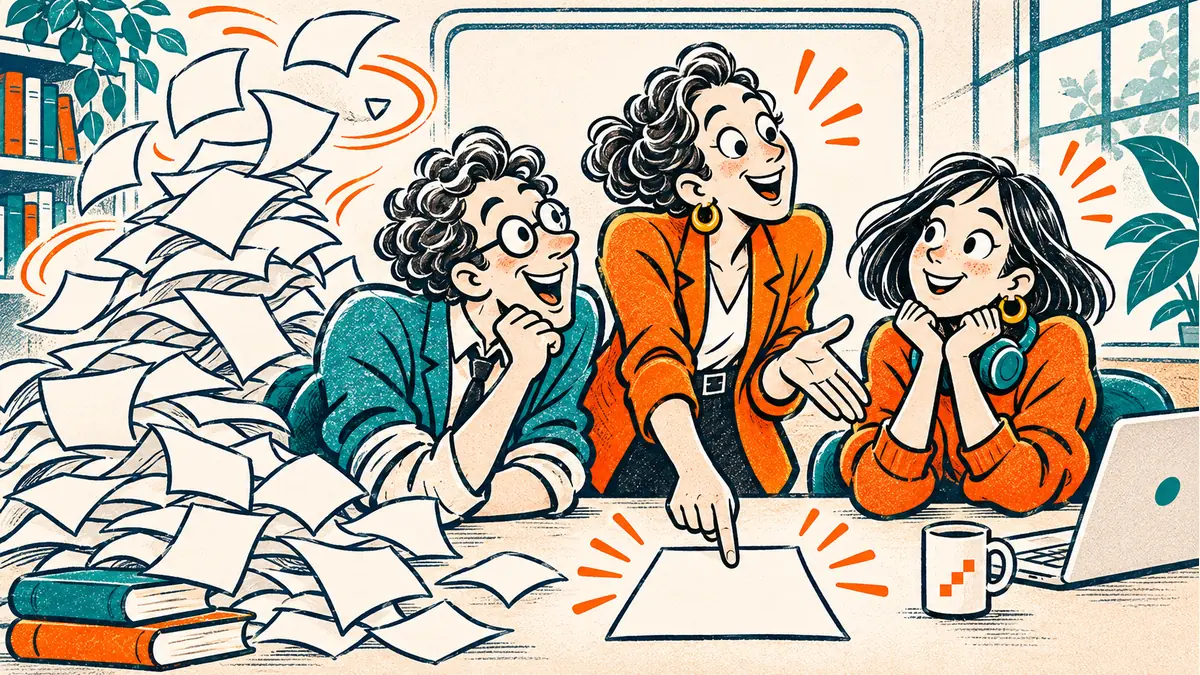
Human-AI Collaboration Coach: Role, Skills & Examples
A Human-AI Collaboration Coach helps people turn AI suggestions into accountable human work. Artificial intelligence can produce an answer in seconds. Getting a team to ask the right question, check the answer and use it responsibly is a different skill. The role is less about mastering one chatbot and more about helping people develop a reliable way of working with AI.
What is a Human-AI Collaboration Coach?
A Human-AI Collaboration Coach is a professional who helps people and teams work effectively, critically and responsibly with artificial intelligence. They teach AI literacy, translate vague requests into clear tasks, design human review steps and help organizations decide when AI assistance is appropriate. The coach strengthens human judgment instead of transferring responsibility to a machine.
Think of a school where teachers already use AI to draft lessons, a company where employees summarize meetings, or a training team that turns long documents into learning materials. In each setting, a tool can generate useful starting points. But who defines a good result? Who checks whether it is accurate? Who notices that a confident answer is irrelevant, biased or based on missing context? Those are collaboration questions, not merely technical questions.
Human–AI Collaboration Coach is an emerging description of a practical role, not a claim that every country or employer recognizes a standardized job title. Similar responsibilities may appear within AI literacy training, instructional coaching, change management, learning and development, or responsible AI adoption.
In this guide: jump to the collaboration method, real-world examples, essential skills, safeguards or frequently asked questions.
- The five-step collaboration method
- A real-world school example
- Essential coaching skills
- Privacy and human responsibility
- Frequently asked questions
Why organizations need more than better prompts
The first wave of workplace AI training often concentrated on prompts: add a role, explain the task, specify a format. That remains useful. Yet a beautifully written prompt does not guarantee a trustworthy decision or a usable result. Teams also need shared expectations, safe handling of information, feedback and clear ownership of the final output.
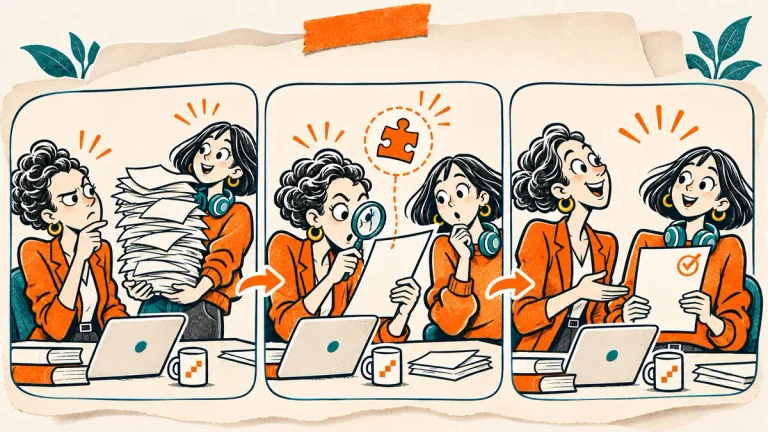
Consider two colleagues preparing a parent information leaflet. One asks AI to “write something professional” and publishes the response. The other defines the audience, provides approved facts, checks every date, asks a colleague to review accessibility and signs off on the final version. The second process is more dependable even if the first prompt looked more impressive.
A collaboration coach helps teams move from isolated experiments to repeatable, human-led workflows. The goal is not to maximize AI usage. It is to improve the quality of work while protecting time, trust, privacy and professional autonomy.
What does the coach actually do?
The work combines facilitation, education, process design and evaluation. In practice, a Human–AI Collaboration Coach may:
- Map real work: identify the task, its purpose, the people involved, the inputs and the decision that follows.
- Build AI literacy: explain capabilities, limitations, uncertainty, fabricated information and safe-use boundaries in plain language.
- Design collaboration protocols: define what AI may draft, what a person must verify and who approves the final result.
- Support different skill levels: help confident users slow down and cautious users experiment in a controlled setting.
- Facilitate team learning: turn individual successes and failures into reusable organizational knowledge.
- Evaluate outcomes: look beyond speed to accuracy, relevance, accessibility, staff confidence and the effort required to correct mistakes.
The coach is not automatically a software developer, cybersecurity specialist, lawyer or organizational decision-maker. Technical implementation belongs with appropriate specialists; legal and compliance conclusions require qualified review. The coach connects these people so that the workflow makes sense to the humans using it.
The five-step Human–AI Collaboration Method
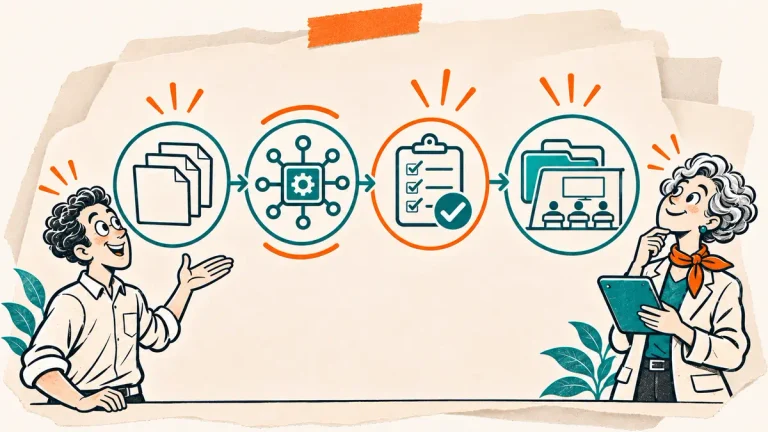
A practical starting point is Understand → Assign → Create → Verify → Improve. The sequence can be applied to a lesson plan, a staff report, a marketing brief or an internal knowledge resource. It creates a shared language that people can remember without learning a different prompt formula every week.
1. Understand the real problem
Before opening an AI tool, ask: What decision or product do we need? Who will use it? What information is authoritative? What would make the result unacceptable? A school leader requesting a “summary of assessment results,” for example, may actually need a short, anonymous overview of learning gaps for a staff meeting. That distinction changes both the instructions and the data-handling rules.
2. Assign appropriate work to AI and people
Separate tasks that AI can assist with from responsibilities that remain human. AI might propose an outline, compare wording options or generate practice questions. A teacher decides whether the material matches the curriculum, supports learners and reflects actual classroom needs. When identifiable student data or confidential business information is involved, the team must follow its applicable policies and use only approved systems.
3. Create with clear context
Give the system a well-defined assignment: the audience, source material, output format, constraints and quality criteria. Ask it to distinguish known facts from suggestions, show assumptions and flag missing information. A useful first draft is not necessarily a finished product. It is material for professional review.
4. Verify against independent criteria
Check factual claims against the original sources. Review tone, bias, readability, accessibility and possible privacy risks. Ask whether the proposed solution genuinely serves the task. The person responsible for the work must be able to explain and defend the final result without relying on “the AI said so.”
5. Improve the process, not only the text
Record what the team learned: which instructions worked, which errors repeated, what review took the most time and whether the result was useful. Update the shared protocol. This turns a one-off experiment into organizational learning and reduces the need to reinvent the process with every new tool.
Example 1: coaching teachers in a real school workflow
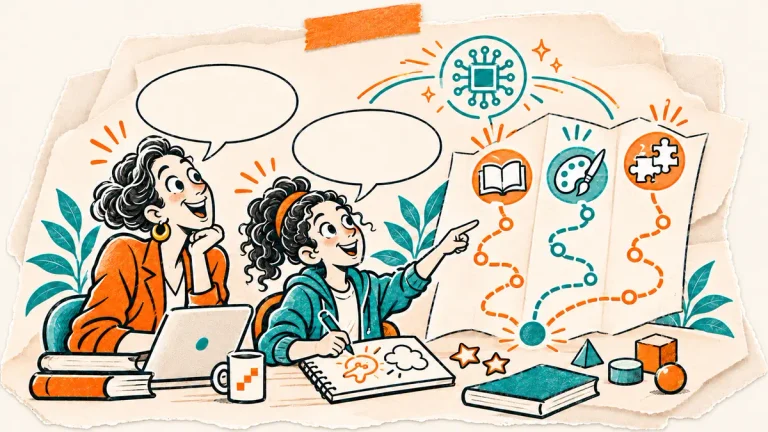
Imagine a group of teachers preparing differentiated reading activities for a mixed-ability class. They have limited preparation time, but they are rightly concerned about inaccurate examples, age-inappropriate wording and tasks that look engaging without assessing the intended skill.
The coach starts with a short working session. The teachers agree on the learning objective, age group, lesson duration and success criteria. They select a source text that may lawfully be used and avoid uploading identifiable student records. AI is asked for three activity variants, each at a different level of support, with a clear explanation of the cognitive demand.
Next, teachers check the proposed questions. One discovers that a supposedly advanced task only tests recall. Another notices an ambiguous answer key. Together they revise the activities and create a simple reusable checklist for future lessons.
The achievement is not that the chatbot produced three worksheets. It is that the team gained a shared method for judging educational quality. The coach has improved collaboration and teaching practice, while the teachers remain the pedagogical experts. For related design work, see the role of an AI Learning Experience Designer.
Example 2: AI teamwork in a small organization
Now imagine a small company that wants to use AI for internal meeting summaries and project updates. Different employees have different habits: some paste raw notes into public tools, others distrust any AI-generated text, and managers receive reports in incompatible formats.
The collaboration coach facilitates an agreement: use an approved environment, remove unnecessary personal information, identify decisions and action owners from an authorized source, mark uncertain points and require the meeting owner to confirm the summary before circulation. The team defines one output template with “Decisions,” “Open questions,” “Actions,” and “To verify.”
After several uses, they assess whether the summaries are easier to act upon and how much correction they require. If the process creates more checking work than it saves, the coach changes the design. A tool is successful only when the workflow becomes better for the people who depend on it.
From prompts to protocols: the key distinction
A prompt tells an AI system what to do in one interaction. A collaboration protocol explains how people and AI work together across the entire task. It includes approved inputs, roles, review standards, escalation rules and a final human decision. This distinction matters most when several people repeat a process or when the output may affect others.
For example, “Summarize this document in five bullets” is a prompt. “Use an approved document; extract decisions with page references; identify unresolved questions; have the document owner check every claim; store only the approved summary” is a protocol. The second approach can survive a change of chatbot because it describes responsibilities rather than interface tricks.
If the team also needs to connect AI to systems, documents and repeatable operational steps, the complementary role of an AI Implementation Specialist becomes relevant.
A reusable human–AI task template
A coach can teach a short framework that works across professions. Replace the bracketed items with non-sensitive information relevant to the task:
Role: Act as a drafting and reasoning assistant, not the final decision-maker.
Context: We are preparing [output] for [audience] using [approved sources].
Goal: Help us achieve [specific outcome].
Boundaries: Do not invent facts, names, citations or policies. Flag missing information.
Output: Provide [format] with assumptions and items requiring verification.
Review: We will check [accuracy, relevance, safety and accessibility] before use.
This is deliberately a starting point. For consequential work, teams need stronger controls, approved tools and subject-matter review. The coach’s job is to teach the difference between a convenient template and a genuinely adequate process.
The skills that make a good Human-AI Collaboration Coach
AI literacy without unnecessary jargon
The coach should understand what generative models commonly do well, why outputs can be incorrect and why fluency is not proof. They should know how to explain uncertainty and recognize when a task requires domain expertise, reliable retrieval or a different tool altogether.
Learning design and facilitation
Adults learn more effectively when they can work with their own meaningful tasks. A coach designs small exercises, creates psychological safety for questions and invites participants to compare outputs. The aim is confidence grounded in evidence, not confidence manufactured by a flashy demo.
Workflow thinking and documentation
Good coaches make invisible steps visible. They can map a process, define responsibilities, maintain simple checklists and turn lessons learned into a versioned protocol. They understand that the first recipient of an AI output may be another person, a team or a controlled internal system.
Critical evaluation and ethical judgment
They notice unsupported claims, stereotypes, accidental disclosure risks and situations where automation would weaken accountability. They know when to stop and involve IT, security, a data protection officer, management or another qualified expert.
Communication across generations and roles
A teacher with thirty years of classroom experience, a Generation Z employee and a school leader may approach AI with different expectations. Useful coaching begins with their responsibilities and experience, not assumptions based on age. The goal is a common working language while respecting differences in expertise.
How to measure whether the coaching worked
Counting prompts or generated pages measures activity, not value. A short evaluation rubric can compare the workflow before and after coaching. Rate each dimension from 0 (not met) to 2 (consistently met), using actual work samples:
- Task fit: Does the output solve the original problem?
- Accuracy: Are important claims supported by authoritative sources?
- Human accountability: Is the reviewer and final decision-maker clearly identified?
- Information safety: Were approved tools and data rules followed?
- Usability: Can the intended audience understand and apply the result?
- Effort: Does the total time, including verification and corrections, justify using AI?
A high score on speed should never compensate for a serious failure in privacy, fairness or correctness. Coaches should look for repeated improvement and document failures as carefully as successes. This makes evaluation a learning tool rather than a marketing statistic.
Safety, privacy and human responsibility
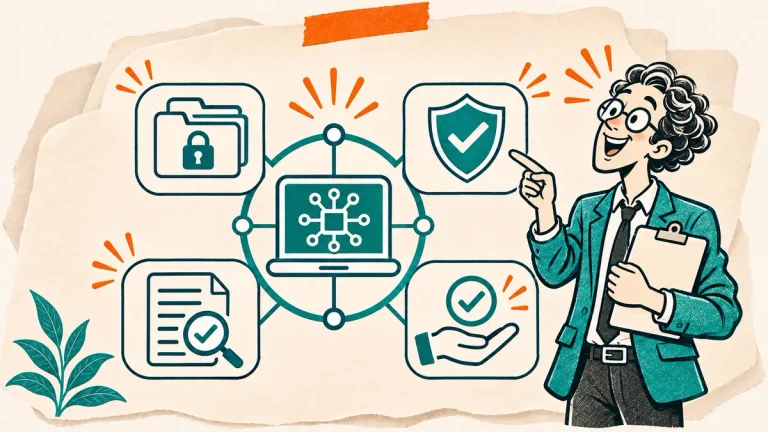
AI collaboration is not a license to upload whatever is convenient. Schools and businesses need rules for confidential records, student information, intellectual property, vendor access and retention. Teams should practice with synthetic or appropriately anonymized examples until approved procedures are in place. Decisions concerning assessment, employment, health or legal rights require particular care and qualified human oversight.
The UNESCO AI Competency Framework for Teachers places human-centred practice, ethics, AI knowledge, pedagogy and professional learning within teacher development. The NIST AI Risk Management Framework provides a wider voluntary approach to identifying and managing AI risks. Neither resource removes the need for local institutional policies.
For European organizations, Article 4 of the EU AI Act and the European Commission’s AI literacy guidance are particularly relevant: providers and deployers of AI systems are expected to take context-appropriate measures to support staff AI literacy. There is no universal requirement for everyone to complete one specific course. The precise responsibilities depend on the system, setting and applicable rules; this article is educational information, not legal advice.
Responsible collaboration also means knowing when not to use AI. If the task has no safe approved input route, if a claim cannot be verified, or if the tool obscures rather than clarifies responsibility, the coach should recommend a different process.
How to develop this role: a practical 30-day pathway
You do not need to begin with an elaborate AI department. Start with one recurring task in an environment you understand, preferably one that does not require sensitive data.
- Week 1 — Observe: interview users, map the existing process, identify friction and write a definition of success.
- Week 2 — Prototype: select an approved tool, build a small task protocol and test it with realistic, safe examples.
- Week 3 — Evaluate: invite two or three colleagues to use the process, record errors and compare outputs with the original workflow.
- Week 4 — Teach and revise: run a short peer-learning session, document decisions and publish an internal version of the protocol.
The evidence of competence is not a certificate-shaped screenshot of a chatbot. It is the ability to explain the task, demonstrate a safer process, show what changed and identify what remains imperfect. A portfolio might contain anonymized workflow maps, training materials, evaluation rubrics and carefully documented case studies.
Where the role fits alongside other AI professions
The Human–AI Collaboration Coach concentrates on people, learning habits and shared practices. An AI Implementation Specialist focuses more on operational design and integrating AI into workflows. An AI Governance Architect develops organizational controls, responsibilities and oversight structures. An AI Content Verification Editor specializes in examining AI-generated content for publication or professional use.
In a small organization, one person may perform several of these functions. In a larger institution, they can become distinct roles. Clear boundaries make cooperation easier: a coach should not promise that a training session alone resolves governance, data protection or technical security requirements.
Frequently asked questions
Is a Human-AI Collaboration Coach a real job?
It is a useful name for an emerging set of responsibilities, though not a universally standardized occupation. Employers may describe similar work as AI adoption coaching, AI literacy training, digital transformation support, learning and development, or human-centred AI facilitation.
How is this different from a prompt engineer?
A prompt engineer concentrates primarily on instructions and interactions with AI systems. A collaboration coach also works with people, team dynamics, verification, process ownership, training and the conditions under which an AI-assisted result may be used.
Do coaches need to know how to code?
Not necessarily. Technical literacy helps, but many coaching tasks involve facilitation, evaluation and workflow design. Coding becomes more important when the role includes automation or system integration, which should involve competent technical specialists.
Can schools benefit from this role?
Yes. A coach can help teachers plan safe AI-assisted work, compare learning resources, develop verification routines and protect pedagogical judgment. Teachers still decide what students should learn and how achievement should be assessed.
Will better AI collaboration eliminate the need for human review?
No. A good process may make review more efficient and targeted, but important claims, sensitive decisions and outputs affecting other people still require appropriate checks and accountable humans.
How can a small team start without a budget for a new position?
Assign a knowledgeable facilitator to one low-risk pilot task. Define success, build a short protocol, use an approved tool and review real outcomes. Expand only when the team can demonstrate that the approach adds value without creating unacceptable risks.
The bigger lesson: better judgment is the real outcome
The strongest Human–AI Collaboration Coach is not the person with the longest library of prompts. It is the person who helps a team ask better questions, notice mistakes sooner, protect what matters and retain ownership of its decisions. The technology will change; the habits of understanding, assigning, creating, verifying and improving can endure.
Start with one real task. Map who needs the result, define the standards, let AI help where it is genuinely useful and make the human review visible. That is a more meaningful beginning than asking every employee to become an AI expert overnight.
Sources and further reading
- UNESCO — AI Competency Framework for Teachers (2024): human-centred teacher competence and AI pedagogy.
- NIST — AI Risk Management Framework: organizational approaches to AI trustworthiness and risk management.
- European Commission — AI Literacy: Questions & Answers: Article 4 requirements, context and practical guidance.
Editorial transparency: AI tools may have been used to support language refinement, structure and formatting. The article was reviewed before publication.